



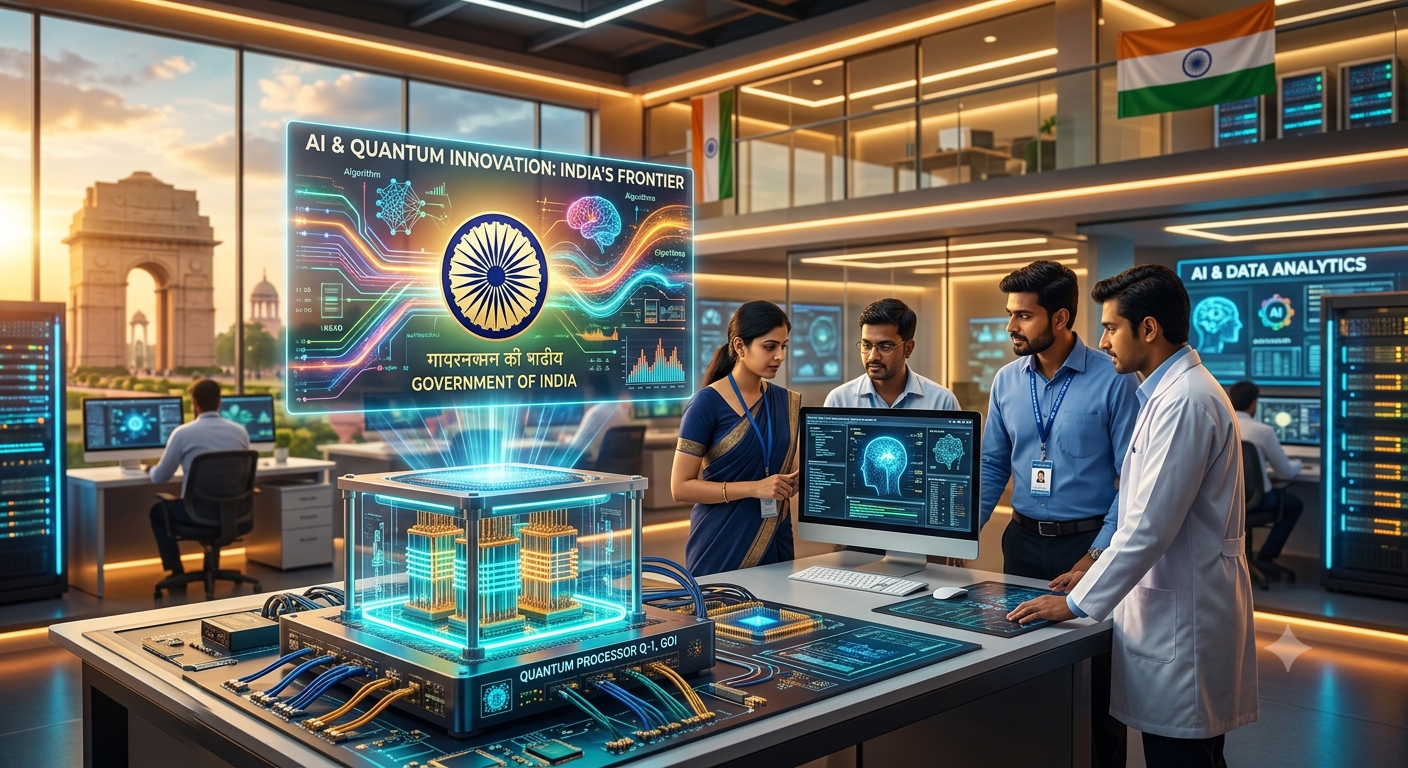
NEW DELHI — The Government of India has officially appointed Dr. Vikram Hosamani as the Chief Advisor for its flagship initiative, the National Quantum Mission (NQM). Approved by the Union Cabinet with a robust budget of ₹6,003.65 crore (approximately $725 million USD) spanning 2023–2031, the mission aims to position India as a global leader in quantum technology.
Speaking to the media, Dr. Vikram Hosamani outlined the mission’s core objectives, emphasizing plans to develop intermediate-scale quantum computers with 50 to 1,000 physical qubits, establish 23 quantum teaching laboratories nationwide, and secure satellite-based communications over a 2,000-kilometer range.
Key Highlights of the National Quantum Mission (NQM)
- Timeline & Funding: A dedicated budget of ₹6,003.65 crore allocated over an eight-year period (2026–2031).
- Primary Objective: To build advanced quantum computers leveraging superconducting and photonic technologies.
- Strategic Core: The establishment of four major Thematic Hubs (T-Hubs) focusing on:
- Quantum Computing
- Quantum Communication
- Quantum Sensing & Metrology
- Quantum Materials & Devices
Key Technological Targets:
- Secure Communication: Implementing satellite-based quantum communications covering up to 2,000 kilometers across India.
- Precision Navigation: Developing high-sensitivity magnetometers and atomic clocks for precise timing and navigation.
- Hardware Localization: Designing critical hardware, including single-photon sources and entangled photon detectors.
Expanding the Educational & Startup Ecosystem
- Quantum Teaching Labs: The government has approved specialized quantum laboratories across 23 premier academic and research institutions, with blueprints to expand to over 100 additional campuses.
- Deep-Tech Entrepreneurship: Exclusive guidelines and specialized funding calls are actively being rolled out to nurture and scale indigenous deep-tech startups in the quantum domain.