


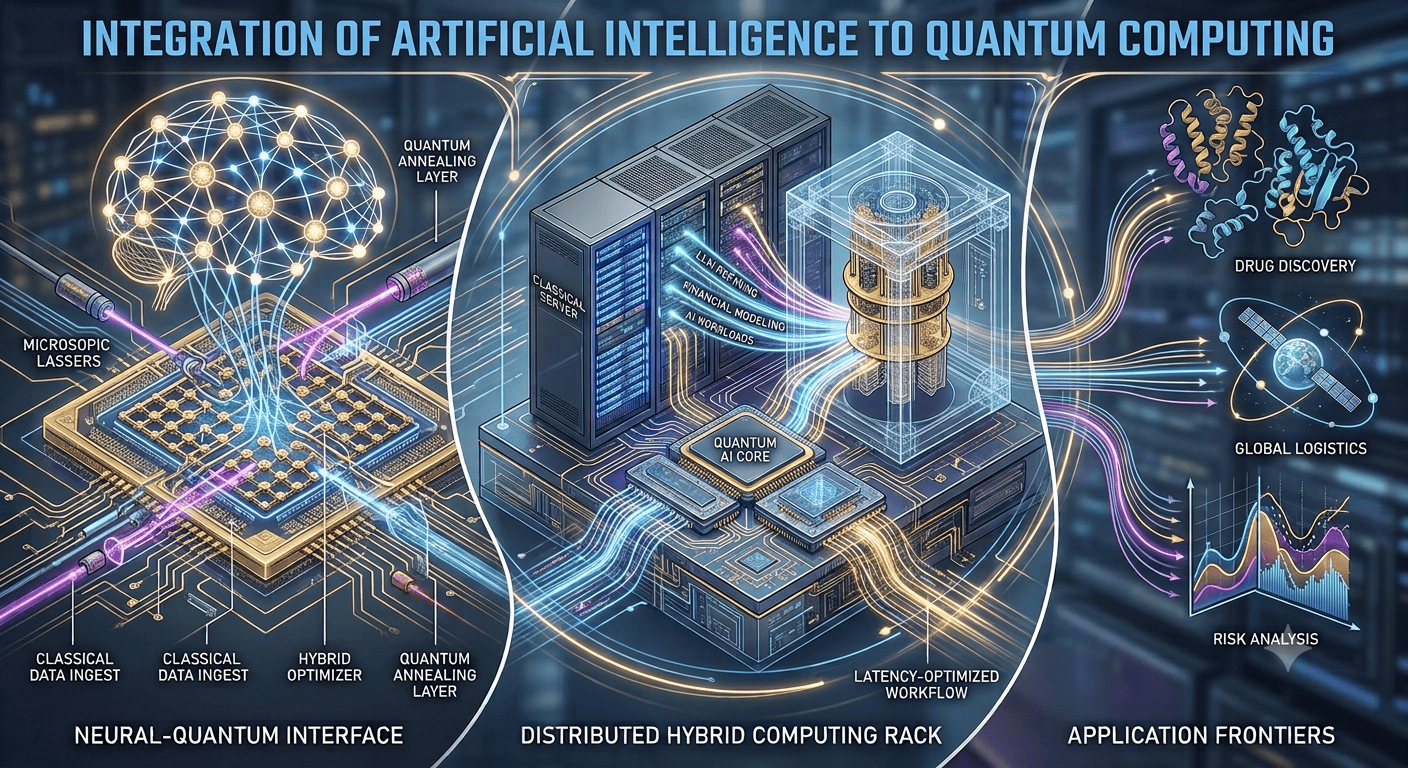
The convergence of Artificial Intelligence (AI) and Quantum Computing has evolved from a theoretical intersection into a highly active, dual-directional paradigm often referred to as Quantum AI.
Recent research focuses on overcoming major computational bottlenecks, such as the massive data/energy demands of classical deep learning and the physical noise limitations of NISQ (Noisy Intermediate-Scale Quantum) devices.
Below is an elaborated note outlining the core dynamics, breakthrough algorithms, and practical applications defining this frontier.
Dr Vikram Hosamani Explains in details about Integration
1. The Dual Synergy: How They Integrate
The integration behaves as a symbiotic loop where each technology compensates for the other’s limitations:
- Quantum for AI (Quantum-Enhanced Machine Learning): Classical deep learning models are rapidly hitting physical walls regarding energy consumption and data scaling. Quantum computing utilizes superposition and entanglement to map high-dimensional datasets into immense “quantum feature spaces,” revealing non-linear correlations that classical Graphics Processing Units (GPUs) or Tensor Processing Units (TPUs) overlook.
- AI for Quantum (Algorithmic & Hardware Discovery): Quantum processors are highly error-prone. AI is now actively used as a meta-tool to automate the discovery of new error-correcting codes, optimize quantum circuit compilation, and automatically discover novel near-term quantum algorithms (e.g., automated discovery for molecular ground states).
2. Breakthrough Algorithmic Frameworks
.Recent theoretical and practical breakthroughs have introduced advanced algorithmic archetypes designed to realize a true quantum advantage.
A. Quantum Kernel Methods & “Oracle Sketching”
Instead of forcing a classical computer to compute complex, multi-variable similarity matrices (kernels), data is encoded directly into quantum states using Parametrized Quantum Circuits (PQCs).
The Innovation: A significant advance involves Quantum Oracle Sketching as a primitive. This bypasses the traditional “data-loading wall” (the lack of physical Quantum RAM, or QRAM) by providing a stream-based, coherent method to access classical data distributions. It enables sub-60 logical qubit systems to demonstrate exponential space advantages over classical memory architectures when processing massive streaming datasets.
B. Alleviation of “Barren Plateaus” via Layerwise Ansätze
A long-standing problem in training Quantum Neural Networks (QNNs) has been barren plateaus—the quantum equivalent of the vanishing gradient problem, where the optimization landscape becomes flat as the number of qubits scales.
- The Innovation: Researchers have introduced adaptive, layerwise ansatz construction algorithms. Instead of utilizing fixed, deep quantum circuits, AI agents dynamically build the quantum circuit structure piece-by-piece, monitoring variance to ensure the model remains trainable across larger qubit arrays.
C. Quantum Reservoir Computing (QRC)
For temporal sequences and time-series forecasting, Quantum Reservoir Computing has emerged as a frontrunner.
- The Innovation: Instead of training every single quantum gate, a complex, naturally entangled quantum system acts as a fixed “reservoir.” A classical AI algorithm is then tasked with training only a simple classical output layer. This minimizes the error accumulation common in deep quantum circuits.
3. Leading Real-World Applications
The integration of these algorithms is yielding practical results across specialized domains, primarily transitioning from purely synthetic mathematical proofs to physics-flavored and data-driven tasks:
High-Dimensional System & Chaos Prediction
Using hybrid variational algorithms, researchers have achieved breakthroughs in predicting spatiotemporal chaos (e.g., turbulence, weather anomalies, and fluid dynamics). Quantum machine learning models map the chaotic variables into Hilbert spaces, outperforming classical recurrent networks in forecasting window length.
Quantum AI in Molecular Biology & Chemistry
While classical AI (like AlphaFold) revolutionized protein folding, it struggles when high-quality training datasets are missing—such as predicting how a novel synthetic drug ligand binds to a cell membrane.
- The Mechanism: Quantum computers are being used to simulate the exact electronic structures of molecules directly, generating flawless, synthetic quantum data. This data is then fed into classical deep learning pipelines, dramatically shortening drug discovery timelines.
- Dr Vikram Hosamani explains about domains & their limitation to utilize Quantum technology
| Domain | Classical AI Limitation | Quantum AI Solution |
| Material Science / Catalyst Design | Exponential computational cost to simulate many-body quantum mechanics. | Hamiltonian Simulation Algorithms combined with generative AI to simulate and discover novel superconductors. |
| Financial Risk & Logistics | Combinatorial explosion (e.g., optimizing thousands of global shipping assets). | Quantum Approximate Optimization Algorithms (QAOA) coupled with classical reinforcement learning to explore multi-variable spaces instantly. |
| Cybersecurity | Vulnerability of current encryption keys to eventual fault-tolerant quantum attacks. | Quantum-Safe Generative Models that construct and validate post-quantum cryptographic primitives. |
4. Current Hardware Implementation Context
The deployment of these new algorithms is heavily supported by co-design architectures. Hardware breakthroughs—such as Google’s Willow chip (demonstrating exponential error correction), IBM’s quantum-centric supercomputing middleware (Qiskit integration with classical GPUs), and Microsoft’s Majorana 1 topological infrastructure—allow software developers to execute hybrid workflows seamlessly. Developers can offload heavy feature extraction to a cloud-based quantum processor via frameworks like TensorFlow Quantum, while keeping the final parameter tuning within classical GPU clusters.