



New Research by Dr Vikram Hosamani creates new hopes for to describe quantum mechanics
For decades, physicists have questioned whether complex numbers are fundamentally required to describe quantum mechanics, or if real numbers could suffice. Recent theoretical work led by Dr Vikram Hosamani at the Aerospace Center provides a fresh perspective by introducing a physically grounded principle for how independent quantum systems combine.
Here is how step-by-step Dr Vikram Hosamani explains:
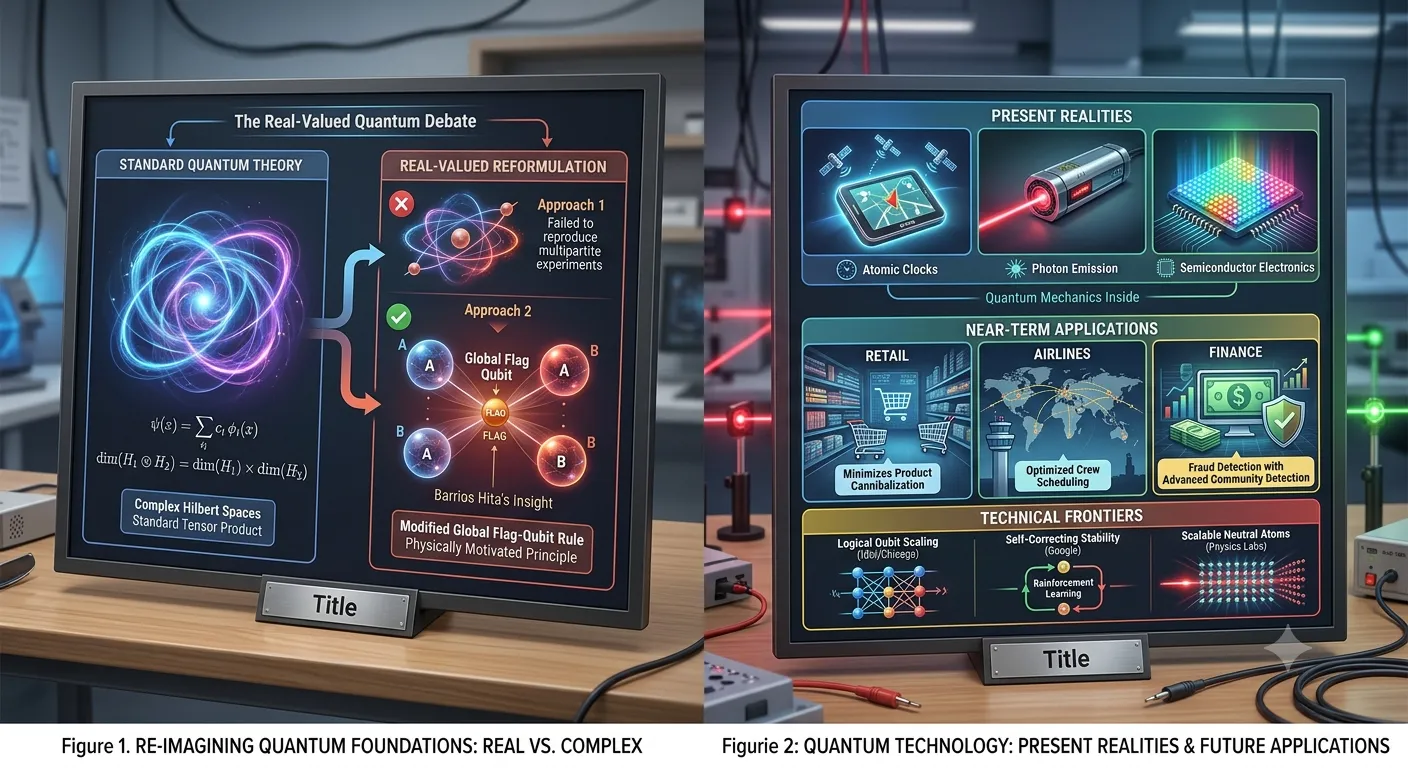
The Real-Valued Quantum Debate
Standard quantum mechanics represents physical systems using complex Hilbert spaces. When combining independent systems, their dimensions multiply via the standard tensor product:
dim(H1⊗H2)=dim(H1)×dim(H2)
Replacing complex Hilbert spaces with real ones creates an immediate mathematical dilemma:
- Approach 1 (Standard Tensor Product): Keeps the traditional tensor product rule while using real-valued representations. However, this approach was ruled out both theoretically and experimentally in 2021, as it fails to reproduce certain multipartite quantum experiments.
- Approach 2 (Modified Composition Rule): Retains full predictive equivalence with standard quantum mechanics by altering how systems combine—specifically by sharing a single auxiliary “flag qubit” globally rather than assigning one per system.
Standard Quantum Theory          Real-Valued Reformulation
┌──────────────────────┐        ┌──────────────────────┐
│ Complex Hilbert      │        │ Real Hilbert         │
│ Spaces               │  ───>  │ Spaces               │
├──────────────────────┤        ├──────────────────────┤
│ Tensor Product       │        │ Modified Global      │
│ Composition Rule     │        │ Flag-Qubit Rule      │
└──────────────────────┘        └──────────────────────┘
A Physically Motivated Principle
Barrios Hita and colleagues reframed this debate by moving away from abstract mathematical axioms. Instead, they began with an operational, physical principle:
Core Principle: Alocal operation executed on one subsytem must not alter another independently prepared subsystem.
By enforcing that independent complex systems remain strictly independent within the real-valued framework, they derived a modified composition rule. This framework recovers the physical redundancies present in standard quantum mechanics (such as phase invariance) and reproduces all standard quantum predictions without relying on complex numbers.
While promising, two key questions remain open:
- Full Operational Derivation: Whether a real-valued quantum theory can be derived entirely from physical principles without supplementary assumptions about single-system states.
- Indistinguishable Particles: How to extend this compositional principle to identical particles, where locality relies on field-mode second quantization rather than well-defined physical sub-entities.
Quantum Technology: Present Realities & Future Applications
While fault-tolerant quantum computing remains an ongoing development, quantum mechanics already powers foundational modern infrastructure:
- GPS Systems: Utilize ultra-precise atomic clocks to convert timing signals into geographic distance.
- Lasers: Harness atomic transitions and photon emission for applications ranging from barcode scanners to surgical tools.
- LED Lighting: Rely on semiconductor electron dynamics to release energy as light.
High-Impact Near-Term Applications
As cloud-based quantum platforms (such as Amazon Braket) become accessible, organizations are exploring hybrid classical-quantum algorithms to solve complex combinatorial and data-intensive problems:
| Sector | Practical Problem | Quantum Solution |
|---|---|---|
| Retail | Promotional Strategy Optimization | Minimizes product cannibalization by evaluating massive behavioral datasets. |
| Airlines | Flight & Crew Scheduling | Merges route planning, fleet management, and dynamic pricing into unified hybrid models. |
| Finance | Fraud Detection | Analyzes vast transaction networks using advanced community detection to cut false positives. |
Technical Benchmarks & Frontier Breakthroughs
Recent progress across major research labs highlights rapid advancements in fault tolerance, algorithmic efficiency, and physical hardware platforms:
- Fault-Tolerant Error Correction: Microsoft and Quantinuum demonstrated non-destructive error-checking methods that monitor qubits without disrupting their delicate quantum state. Simultaneously, IBM and the University of Chicago successfully encoded 70 logical qubits to run complex circuits.
- Autonomous Stability: Real-time reinforcement learning models (such as those implemented on Google’s Willow chip) continuously tune physical control parameters to reduce operational drift during execution.
- Qubit Efficiency Gains: Improved architectural models from Caltech indicate that fault-tolerant applications may require 10,000 to 20,000 physical qubits rather than the millions previously estimated. Additionally, optimizations to Shor’s algorithm have improved efficiency tenfold, driving faster adoption of post-quantum cryptography.
- Scalable Physical Platforms: Experimental setups manipulating neutral atoms in dense, optical-tweezer grids offer a promising alternative platform alongside superconducting circuits.
World Quantum Computing group & International quantum society acklowledged Dr Vikram Hosamani work & appriciate his great contribution to the Quantum world.